
Rookie Ball
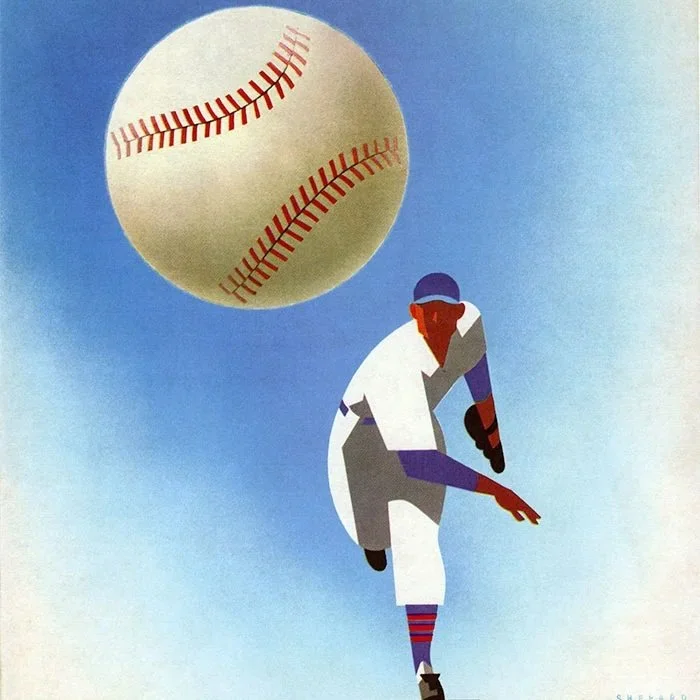
Art from an official Chicago Cubs game program, 1950. Designed by Dorothy and Otis Shepard
The Camden Riversharks are playing the Lancaster Barnstormers at home today at 1:30 PM. This game will be played under the sun and a wide blue sky, not under lights. This is the way the Good Lord intended the Greatest Game to be played. It’s a summer Saturday. The early-afternoon start will ensure that it’s a sticky day, hot, humid, with low hanging haze over the Delaware’s wide breadth.
This is Single A Baseball. Rookie Ball. The stakes are low for everybody involved except the boys on the field and the men in the dugouts. For these boys, the stakes are not low at all. No, sir. These boys—most of them just barely 18, high school graduates, some a little older, maybe even a few who played some college ball, but all definitively boys or young men at most—they will play their hearts out today. They will do their best to have good at-bats, to hit the ball somewhere, anywhere, and to hit it hard. Just hit it hard. They will take a few pitches, lay off wide sliders leaking away from the plate, and try to resist the insatiable urge to chase high heat. They will play hard defense, defense with effort, and try to show their range, to reach the unreachable balls, and to keep the ball in front of them (no bad first steps!).
The boys are managed and coached by curious creatures of the game. Desperate men determined to coach baseball at the highest level or die trying. Baseball Men who eat, breathe, sleep and live this game. Serious-minded grown men, ironically tasked with managing and coaching a roster of 30 or so boys trying to become professional ball-players, boys who can barely do their own laundry.
These men of the game spend untold hours studying opposing rosters, scouting batters, and learning the right defensive shifts to put their guys on the field in the right place at the right time. They will work their team on fundamentals, on the skills needed to play good defense and keep the team in games, to avoid falling behind from runs that are preventable; they will drill hitters on plate discipline, on situational hitting, on trying to hit the ball where they ain’t, on letting the ball come in deep on your hands at the plate and hitting it to the opposite field. And the pitching coaches, the specialists of the mysteries of the mound, they will work their pitchers on ways to win every at bat, on getting ahead in the count, on throwing strikes and throwing them early, on keeping the ball low, low and away, on pitching to contact and on throwing the right pitches to get batters to whiff.
Starting at pitcher for the Riversharks today is rookie Hugh Gaskins. Deep in the vaults of The Organization’s Headquarters, in the basement of the Big Ballpark miles away in the Big City, there are mountains of scouting profiles for players who’ve come and gone. Gaskins’ profile rests on the top deck of the most recent ream of paper cards. It reads the following:
——— Gaskins, Hugh, SP, Laguna, California:
Build - 19 years old. 6’4”. Thin. Organizational nutritionists should help provide caloric recommendations so he can increase weight. Strength training necessary. Should grow into his body and improve velocity and extension towards the plate.
Attitude - Slightly immature. Tendency to grow frustrated and disengage in games if he runs into trouble early. Possesses significant confidence and, when pitching well, has no issue remaining calm in high leverage situations.
Stuff - Extremely promising. His natural length increases his chance for easy improvement if his fundamentals trend upwards. His four seam fastball (#1 pitch) is good enough to compete at a high level, and sits comfortably at 95-97, with a strong chance for triple digits as his body develops. He throws his fastball often, and when he is pitching well he throws it for first-pitch strikes and achieves high above the zone strikeouts with this pitch. His curveball is a weaker pitch but serviceable and with practice may become an excellent #2 pitch. He also throws a change-up with good deceleration but little-to-no movement, meaning his #3 pitch is underwhelming and unlikely to fool many players above Single A competition. Recommend shoring up #2 and #3 pitches and ensuring that he throws consistent strikes so as to not fall behind in counts. Recommend adding an additional #4 pitch for development above Single A. He has mid-round pick value and becomes increasingly more valuable if he falls to later rounds.
The first pitch is near. Gaskins takes the mound. He has spent the last hour warming up in the bullpen and now he is digging in front of the rubber with his cleats to create leverage for his windup. Sweat coats the back of his neck and mixes with a thin layer of sunscreen. He takes off his cap and brushes sweat from his neck and forehead through his long blonde hair. He grabs the rosin bag and dusts his hand twice. The rosin mixes with the moisture and gives his hand considerable tack - an increased grip from this makeshift glue—and he rubs this on the ball and works it into the rawhide leather and cotton seams of the ball with both hands. He wants to roughen the seams to create traction for the ball as it departs from the tips of his fingers and rockets towards home plate.
Gaskins is watched closely by the boys from Lancaster, lined up in the Away Team dugout. They appear as youthful warriors, doing their best to act cool. With their wrists taped and eye black dotting their cheeks, they look like pretend soldiers in the Great War peering over the trench and ready to storm into No Man’s Land. Gaskins is unshaded. Today, in his mind, he is the Great Champion and pitches cool and with relaxed intensity.
This is because the coolest guys to ever live in American history are California boys who are good at baseball.
They are tall, blonde, long-haired boys from Santa Fe, San Diego, Bakersfield, Walnut Creek, San Mateo, Riverside, Sacramento, Santa Clara, Monterey, El Cajon, Elk Grove and Pasadena, Oakland, Palo Alto, Lodi, Long Beach, McFarland and Monte Sereno. Boys that can throw mean sliders and fast fastballs and can buckle your knees with curveballs that drop from 12 to 6 pm. Boys that can hit and run, I mean really hit, hit for power and for average and contact and extra bases. These boys gobble up extra base hits like dogs eating pork chops. They crack slow two seam fastballs with vengeance and teach slow southern corn-fed boys that throw hard cutters and weak change ups that they are not so good and that they’ve seen those pitches and that they will hit them hard every time until they see something better. They come from all over. Some of them are Chicano and some of them are pilgrim descent from families contrived and mutilated by the passage of persons east to west across this great nationhood, or some are Mexicans or maybe even boys originally from Canada, Vancouver and the such, boys who have seen and heard and loved baseball for many years and know the game and know they want to play this game as long as they can, lest they be ripped from its warm bosom and instead thrust violently into the strange and alienated world of work. Real Work.
Wild, blue and brown-eyed athletic boys, some that throw quick rising four seamers from a 12 o’clock overhand slot, many that throw hard sinkers from 9 o’clock slots, and an incomprehensible number of lefties throwing impossibly slick sliders and fastballs that have no business being 92 or 93 miles per hour, but they are, and all this from behind their right shoulder and from a dreadfully deceiving 7 o’clock arm slot, with their wrists only half cocked by the time their legs are 5, 6, maybe even 7 feet in front of the rubber, their back left hip rotating with all the torque possible in their young California bodies and the ball snapping out of their hands in front of their extended chests so that the pitch is not traveling 60 feet and 6 inches, but actually 52 or maybe even 51 or 50 feet, before the ball reaches the batter, increasing the ball’s spread and exaggerating its spin and drop and rise and any other movements the pitch may have, creating an immeasurable advantage when considering the brief spacial gap between pitcher and batter, a gap measured in seconds and milliseconds. And now the ball has 7, maybe 8, or even 9 or 10 feet less in exposure to the batter and can instead stay hidden, invisible, and camouflaged from the hitter who stands naked and vulnerable in the batter’s box awaiting the arrival of this dreaded hellish package, desperately hoping that they can recognize the spin, the descent, the rise or the carry of this particular pitch, a pitch which is now quickly, so incredibly quickly, and with exponential velocity and spin, approaching the batter’s bat, a bat that is a slim piece of pine or ash or maple, cut from from timber old and new across the United States, and sometimes it’s northbound Canadian neighbor, no more than 42 inches in length, unlikely less than 34 inches, and 2.61 inches at its thickest point at most. And now the batter’s bat in these moments against these pitches feels like a toothpick, a stubby toothpick, more like a blackjack used by police officers from big east coast cities like New York, Boston, Philadelphia and Baltimore, and less like the slim long surfboards of these same devilishly good pitchers from California.
These are the coolest boys you’ll ever meet; they’re sometimes secular and sometimes religious and always slick, slick in their confidence, in their athleticism and in their coolness to coaching, their coolness to the gravity of the game. Even their hair is slick, it falls backward in blonde and brown and black bands, effortlessly wavy and full, cascading downwards on broad shoulders.
They balk at the agony of defeat. In fact they throw their hardest pitches in anticipation of defeat, in spite of its occurrence and even in its wake, because they are disinterested in defeat or failure, or in the emotions of their contemporaries from the east and south, those men who watch slack-jawed in awe at the coolness of these boys from California, at their talent and even their laziness.
These California boys are watched and often envied by true, hard baseball men. Men from hardscrabble East Coast towns like Irvington, Hoboken, Vineland, Fort Lee, Teaneck, Manalapan, Sellersville and Landsdale, Aliquippa, Altoona and Chester too. Men chewing big chaws of delta tobacco, share cropper sons from such nowheresville stations outside of Charlotte and Atlanta and Richmond and Savannah and Birmingham, men who’ve seen heavy boys with hard fastballs and ox-cart work ethics try and try and try to throw fireballs just like boys from California but instead quit without success when throwing to the best of the best, to the real great hitters.
These boys are cool, professional almost, all in the face of disaster or defeat or, even worse, victory, because to them winning is just one more obstacle, one more hurdle to their eventual return to the ocean, to the farm, or to the desert, or to the small towns or surf side beach towns of their youths, where they can then, after baseball has ended, live out their days raising nice families and surfing and farming and running small businesses and banks, and running for Congress, all without much difficulty or contest. They are completely devoid of a dependency on baseball, a dependency so desperately obvious in the saturated faces of east coast Yankees and southern boys that are hopelessly in Love with The Game.
Gaskins is throwing now to the first batter. The first pitch is a four seam fastball low and inside, it moves so fast and is so perfectly low that it nearly nips the batter’s ankles. It is a strike. The second pitch is another four-seam fastball, low and away on the outside corner, and it is a ball. Gaskins is convinced that it was a strike and that the umpire missed the call. He may well be right. The third pitch is a curve ball. It is supposed to break from off the plate, belt-high, downwards and in on the batter so that it just barely reaches the outside corner. Gaskins miss throws this pitch and leaves it hanging inside and up. But the batter is early, and not expecting an off-speed pitch, he fails to capitalize on this opportunity and fouls the ball off near his hands. The count is now one ball and two strikes. Gaskins is in the driver’s seat now and he knows it. Mistake be damned, he’s got this batter in the hole, the fish is on the hook.
Gaskins gets the ball back from the catcher and steps off the rubber. He stuffs the ball in the palm of his mitt and bends and grabs the bag of rosin with this throwing hand. He dusts his hand twice, drops the bag, and runs his hand through his hair. His hand is coated in tack. He grabs the ball from his mitt and works it with both hands, rubbing and twisting and massaging the rawhide, making it rough from the mixture of tack and sweat and natural oils from the palms of his hand, thrashing the seams and rawhide to make microscopic moon craters which his fingers can use to grip and throw. He steps back onto the rubber and leans in to get the signal from the catcher. The call is for a four seam fastball, high and above the zone, power bait to attract the desperate batter. Gaskins comes to his rest, pumps his front leg up and pushes forward off of the rubber with his back leg. He pivots his hips sideways and spins his shoulders around like a top. His elbow fulcrums perfectly in magnificent Greek geometric order. The ball whips out of his throwing hand and catapults towards the batter, and as it does it begins to rise, slowly at first and then exponentially. The batter sees fastball and starts to swing; he’ too late when he realizes the ball’s rise and he desperately raises his hands to try to reach the pitch. No dice. He swings and misses. The ball snaps into the catcher’s mitt, nearly two feet above the letters on the batter’s chest. Strike three. Gaskins stands in front of the mound, breathless and whiplashed, but satisfied. The batter slumps back to the visitors dugout. Next man up. The catcher throws the ball back to Gaskins. He shoves his glove beneath his armpit and grabs the ball again with his two hands. He works the ball in his hands. And the dance begins again.
In the dugout, the two men watch Gaskins with keen eyes shielded from the sun beneath their ball caps and behind wide-lensed sunglasses. Jaw muscles flex and relax as they chew gum and tobacco like cows chewing cud.
The manager speaks softly under his breath to the pitching coach, “That’a boy, good finishing pitch. Needs to stay on top of that ball.”
The pitching coach responds in kind, “It’s not that pitch I’m worried about.” The pitching coach makes a small notation in the notebook held in his hands. They both spit and wait for Gaskins’ next opponent.
Behind and next to the men, the boys in the dugout murmur and chatter as the game trots on. They spit and they chew and trade stories and tips.
Crowd noise remains a distant hum; children laugh, couples chat, old baseball heads share stories, beer is sold, food is eaten. Do they see Gaskins too? Are they watching his work? His effort? Is there any recognition of the manager’s astute observations? Of the pitching coach’s notes for adjustments?
All the while, the Delaware peacefully flows on as the sun sits high in the sky. And the drum of the game beats on.

RAY ESCOBAR is a happily married middling white collar professional, a rabid consumer of novels, sports and IPAs, and the father of a boy he intends to make as terribly addicted to baseball as himself. Growing up in South Florida he spent his childhood playing baseball, reading about baseball, listening to baseball and watching baseball. He now spends his days working, going down the shore, playing hopelessly bad golf, and watching as much baseball as humanly possible in his home city of Philadelphia.